






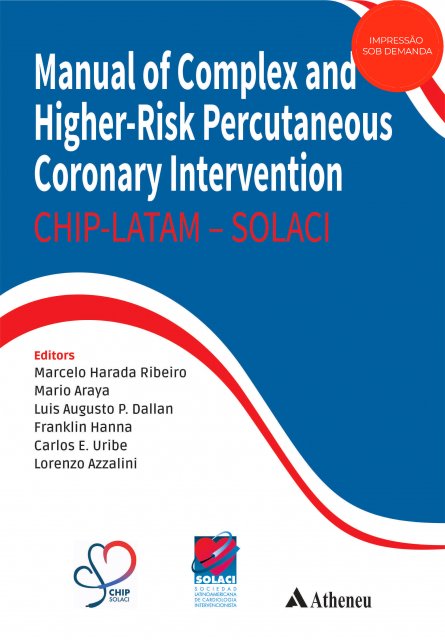
Manual of Complex and Higher-Risk Percutaneous Coronary Intervention (POD)
Consulte o prazo de entrega
POD: Para as compras de obras POD realizadas no site, cabe esclarecer que os prazos de entrega são maiores, tendo em vista que o processo de impressão sob encomenda só é iniciado após a confirmação do pedido, e que o processo gráfico e produção de capas duras pode se estender por até 20 dias úteis além do prazo normal válido para uma outra obra impressa já disponível em nosso estoque
Especificações
Autores:
Luiz Augusto Palma Dallan
Dimensões:
16x23
Edição:
1
Impressão Sob Demanda:
POD
ISBN:
9786555868050
Lançamento:
01/08/2024
Livro Digital:
eBook
Marca:
Editora Atheneu Ltda.
Páginas:
516
Peso:
1020
Resenha
Sumário
Manual of Complex and Higher-Risk Percutaneous Coronary Intervention - CHIP-LATAM – SOLACI is a collectively authored book, written by renowned specialists from Latin America and Key Opinion Leaders worldwide.
It details the latest and best evidence in modern Interventional Cardiology, providing in-depth information and relevant insights.
The didactic proposal is interspersed with its own title: to provide the readers with theoretical and conceptual knowledge, procedures and practice in advanced Interventional Cardiology.
Also provides technical indications and guidance on how best to manage specific topics:
1) Left main coronary artery interventions.
2) Intravascular imaging.
2) Chronic total occlusions.
3) Calcified lesions.
4) Mechanical circulatory support.
Manual of Complex and Higher-Risk Percutaneous Coronary Intervention - CHIP-LATAM – SOLACI features 6 editors, 10 co-editors, 99 collaborators, 5 sections, 36 chapters and 516 pages.
The book's target audience is: Internal Medicine, Clinical Cardiologists, Cardiac Surgeons, Interventional Cardiologists, Residents, Fellows and Healthcare Providers in the Catheterization Laboratory.
Section 1 | Toolbox for Complex Percutaneous Interventions
1 | Indications for CHIP (Complex and Higher-Risk Percutaneous Coronary Intervention), 3
2 | Toolbox for CHIP – Equipment (Guidewires, Microcatheters), 15
3 | Challenging Femoral Access for CHIP – Tips and Tricks, 31
4 | Radial Artery Access and Alternative Access for Complex and Higher-Risk Percutaneous Coronary Intervention, 39
5 | Anesthetic Considerations for Complex PCI, 53
Section 2 | Left Main and Coronary Artery Complex Percutaneous Interventions
6 | Intravascular Imaging for Left Main Coronary Interventions, 67
7 | Intravascular Imaging for Complex Coronary Interventions (Non-Left Main), 81
8 | PCI Assessment for LM Bifurcation: How to Choose the Best Technique, 95
9 | PCI Management of the Left Main Bifurcations: Provisional Stent Technique – Technical Aspects, 109
10 | PCI management of the Left Main Bifurcations: Two Stents Technique – Technical Aspects, 121
11 | Left Main Coronary Artery Calcium Modification Strategies, 153
12 | Left Main PCI in Special Conditions: Aortic Stenosis and Post-TAVI Subsets, 167
13 | PCI Management of Small Vessels: Current Role of Drug-Coated Balloons, 177
14 | Saphenous Vein Graft Interventions, 189
15 | Antiplatelet Therapy in PCI, 199
16 | Assessment and Treatment of High Thrombus Burden Lesions, 213
17 | No Reflow and Its Management, 229
Section 3 | Chronic Total Occlusions
18 | CTO Indications, 245
19 | Antegrade Wire Escalation (AWE) Strategies for Chronic Total Occlusions (CTO), 255
20 | Antegrade Dissection: Tools and Techniques, 265
21 | Antegrade Reentry: Tools and Techniques, 277
22 | Retrograde Approach to Chronic Total Occlusions, 295
23 | Management of CTO Complications, 307
24 | Intravascular Imaging Assessment for Chronic Total Occlusion Percutaneous Coronary Interventions, 323
25 | Advances and New CTO Techniques, 333
Section 4 | Calcified Lesions
26 | Lithotripsy Atherectomy: Indications and How to do it, 345
27 | Rotational Atherectomy, 355
28 | Coronary Calcium Modification: Orbital Atherectomy (OA), 371
29 | Uncrossable and Undilatable Lesions, 379
30 | Complex High-Risk Interventions for in-Stent Restenosis, 387
31 | Calcified Bifurcation Lesions: Tips and Tricks, 399
Section 5 | Mechanical Circulatory Support
32 | Intra-Aortic Balloon Pump Support, 411
33 | When to Use Mechanical Circulatory Support for CHIP: Protected PCI, 421
34 | Percutaneous Therapies for Advanced Heart Failure: an Overview (ECMO), 439
35 | Algorhythm for Mechanical Circulatory Support in Shock Patients, 451
36 | Future Perspectives for CHIP: How Can We Improve the Outcomes, 465

0.0